
Maple tree removal typically costs between $600 and $3,500, with most homeowners paying roughly $1,200 to $2,000 for an average yard maple. Small maples under 30 feet often land in the $600–$1,000 range, while large, mature specimens over 60 feet can run $3,000–$7,500 when a crane or tight access is involved. Stump grinding is almost always billed separately, adding about $180–$525.
Maples are one of the most common shade trees in North American yards, and they are also one of the more expensive species to take down. Their dense hardwood, wide spreading canopies, and habit of growing close to houses and driveways all push the price up. This guide breaks down what you should actually expect to pay, what drives the number up or down, and where there is room to negotiate.
Prices below reflect national ranges published by major home-services cost guides in 2026. Tree work is intensely local, so treat these as planning figures rather than quotes — the only number that matters is a written estimate from a licensed, insured company that has walked your property.
How much does maple tree removal cost?
Maple tree removal cost is driven first by height and trunk diameter, because those two figures determine how long the crew is on site and what equipment they need. Here is how the ranges break down by size.
| Maple size | Typical height | Typical cost range | What the job usually involves |
|---|---|---|---|
| Small | Under 30 ft | $400–$1,000 | Two-person crew, half day, no crane |
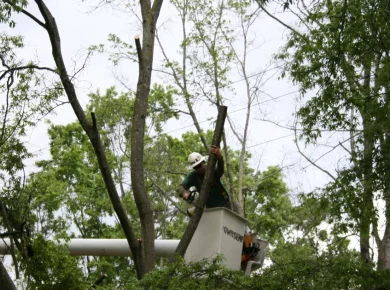
| Medium | 30–50 ft | $900–$2,200 | Climbing or bucket truck, rigging limbs down |
| Large | 50–70 ft | $1,500–$3,500 | Full crew, bucket truck, sectional dismantling |
| Very large / mature | 70 ft+ | $3,000–$7,500+ | Crane, road permits, multi-day work |
Most residential maples fall into the medium-to-large bands. A healthy 45-foot red maple in an open backyard with a clear drop zone is a straightforward job. The same tree wedged between a garage and a power line can easily double in price, because the crew has to take it down piece by piece and lower each section on ropes.
Is maple removal priced per foot?
Some companies quote a rough per-foot figure — commonly $10 to $30 per foot of height — but this is a shorthand, not a real pricing model. Two 50-foot maples on the same street can differ by $1,500 based on access alone. Use per-foot math to sanity-check a quote, never to replace one. Our tree removal cost calculator and the breakdown in tree removal cost by size give a more realistic starting range.
Why maples cost more than many other trees
Maple is a hardwood, and that single fact explains most of the price premium. Compared with a softwood like pine of the same height, a maple takes longer to cut, dulls chains faster, and produces far heavier wood that is harder to lower safely and more expensive to haul away.
- Dense wood. Maple weighs substantially more per cubic foot than pine or spruce, which increases rigging time and disposal weight.
- Broad, spreading canopy. Maples branch wide rather than straight up, so there are more limbs to remove individually before the trunk comes down.
- Multiple leaders. Silver and Norway maples frequently fork into several competing trunks, each of which has to be dismantled separately.
- Proximity to structures. Maples were planted as street and shade trees for decades, so they are often the tree closest to the house, driveway, or utility line.
- Shallow surface roots. Silver maple in particular sends roots along the surface, which complicates stump grinding and can mean repairing lawn or hardscape afterward.
Maple removal cost by species
Not all maples behave the same way on a job site. Species affects wood density, canopy shape, and typical mature size — and therefore price.
| Maple species | Mature height | Typical removal range | Cost notes |
|---|---|---|---|
| Japanese maple | 10–25 ft | $300–$800 | Small and ornamental; often the cheapest maple to remove |
| Red maple | 40–70 ft | $900–$2,800 | Common yard tree; predictable, moderate-cost job |
| Sugar maple | 60–80 ft | $1,500–$4,000 | Very dense wood; heavier rigging and disposal |
| Norway maple | 40–60 ft | $1,200–$3,000 | Dense canopy; invasive in many regions, sometimes easier to permit |
| Silver maple | 50–80 ft | $1,300–$4,000 | Brittle limbs and surface roots; often storm-damaged |
| Box elder | 30–50 ft | $700–$1,800 | Softer, weaker wood; usually a faster job |
Silver maple deserves a special note. It is fast-growing, weak-wooded, and one of the species most likely to shed large limbs in a storm. If you are getting quotes for a silver maple because of a recent failure, read our guide on emergency tree removal cost — storm work is priced very differently from scheduled removal.
What else changes the price
Beyond size and species, five variables move a maple quote the most.
Access and drop zone
This is the single biggest swing factor after height. A tree a crew can fell in one piece into an open yard is the cheapest possible scenario. If equipment cannot reach the tree, or if the maple overhangs a roof, pool, fence, or power line, expect a premium of roughly 30% to 100%. Crane-assisted removals typically add $500–$1,500 or more to the base price.
Tree condition
A dead, hollow, or storm-damaged maple is more dangerous to climb, so crews often refuse to climb it and bring in a bucket truck or crane instead. That raises cost even though the tree may be smaller. See dead tree removal cost for how condition changes the math, and how to tell if a tree is dying if you are not sure yet.
Permits and protected trees
Many municipalities require a permit to remove a healthy tree above a certain trunk diameter, and some list mature maples as protected or heritage trees. Permit fees are usually modest, but the arborist report that may be required is not. Check your local rules before you schedule work — removing a protected tree without approval can trigger significant fines.
Cleanup, hauling, and stump
Ask exactly what “removal” includes. Some quotes stop at felling the tree and leaving the wood on site.
| Add-on service | Typical added cost |
|---|---|
| Stump grinding | $180–$525 |
| Full stump and root removal | $350–$800 |
| Haul away logs and brush | $100–$500 |
| Wood chipping on site | $75–$200 |
| Log splitting into firewood | $75–$150 |
Season and scheduling
Late winter and early spring — after storm season, before the summer rush — is often the cheapest window to book non-urgent removal. Crews have open calendars, and a leafless maple is faster to dismantle because there is less canopy to clear.
How to bring the cost down
- Get three written estimates. Spreads of 40% or more on identical work are common. Our guide to a tree removal estimate explains what a complete quote should list.
- Book off-season. Avoid the weeks immediately after a major storm, when demand and prices spike.
- Keep the wood. Declining haul-away and splitting the logs yourself can cut several hundred dollars if you have a use for firewood.
- Bundle jobs. Removing two trees on one visit is cheaper per tree than two separate mobilizations.
- Clear the site yourself. Moving vehicles, patio furniture, and fencing panels before the crew arrives reduces setup time.
- Verify insurance, then negotiate. Never choose on price alone — confirm liability and workers’ compensation coverage first, then ask the company you trust to match a lower quote.
Should the maple come out at all?
Removal is not always the answer. Maples respond well to corrective pruning, cabling, and soil care, and a structurally sound tree adds real value to a property. The International Society of Arboriculture’s tree owner resources outline when treatment is a reasonable alternative to removal.
Removal usually becomes the right call when the tree is dead or more than about half dead, when there is significant trunk decay or root-plate movement, when a large defect overhangs a target you cannot move, or when repeated failures make the tree a recurring hazard. If you are weighing the decision, when to remove a tree and how to save a dying tree walk through the assessment. An independent consulting arborist — one who does not also sell removal — is the most reliable second opinion.
Frequently asked questions
How much does it cost to remove a large maple tree?
A large maple of 50 to 70 feet generally costs $1,500 to $3,500 to remove. Trees above 70 feet, or any maple that requires a crane because of limited access, commonly run $3,000 to $7,500 or more.
Is maple more expensive to remove than pine?
Usually yes. At the same height, maple is a dense hardwood with a wide, multi-limbed canopy, while pine is a lighter softwood with a narrower profile. Expect a maple to cost somewhat more than a comparable pine, though access and condition can outweigh species entirely.
Does homeowners insurance cover maple tree removal?
Standard policies generally do not pay to remove a living or declining tree for maintenance reasons. Coverage typically applies only when a covered peril — such as a storm — brings the tree down and it damages an insured structure. Terms vary widely by policy and state, so read yours and speak with your insurer.
How much is stump removal after a maple is cut?
Grinding a maple stump usually adds $180 to $525 depending on diameter, while full removal of the stump and major roots runs $350 to $800. Maples often have wide surface roots, which can push the price toward the upper end.
Do I need a permit to remove a maple in my yard?
It depends entirely on your municipality. Many cities require a permit above a set trunk diameter, and some protect mature or heritage trees regardless of location. Call your local planning or urban forestry office before scheduling the work.
What is the cheapest time of year to remove a maple?
Late winter and early spring are typically the least expensive. Demand is lower than in storm season, and a dormant, leafless maple takes less time to dismantle.
The bottom line
Budget roughly $1,200 to $2,000 for a typical yard maple, less for a small ornamental and considerably more for a mature specimen near a structure. The largest cost levers you control are timing, how many quotes you gather, and whether you keep the wood. Confirm that whoever you hire carries current liability and workers’ compensation insurance, and get the full scope — including stump and cleanup — in writing before work begins.
This article provides general cost information and is not a quote, and it is not legal, insurance, or financial advice. Prices vary significantly by region, site conditions, and season. Consult a licensed arborist or tree service for pricing specific to your property, and your insurer or local authority for coverage and permit questions.

 Jack Turner