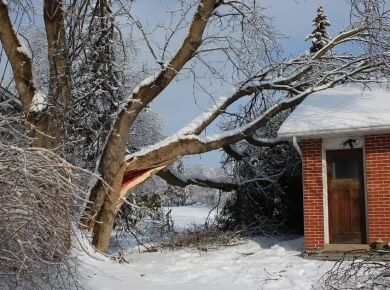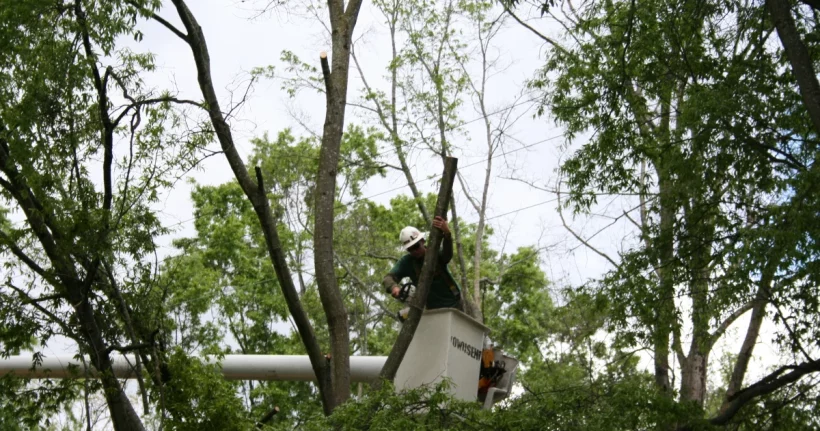

Trim when the tree is structurally sound and the problem is limited to branches. Remove when the defect is in the trunk or roots, when more than about half the tree is dead or damaged, or when the tree cannot be made safe near something it could fall on. Branches grow back. Trunks and root plates do not.
That is the short version, and it is the right instinct in most cases. But “it still has leaves” is not the test, and “just cut the top off” is not a compromise — it is the worst of both options. Here is how arborists actually make the call, what each choice costs, and where the decision stops being yours alone.
Trimming, pruning and removal: what the words mean
The International Society of Arboriculture (ISA) treats pruning as the umbrella term for all selective branch removal, and defines four main techniques: cleaning (taking out dead, dying, diseased or weakly attached branches), raising (removing lower branches for clearance), reduction (decreasing height or spread by cutting back to a suitable lateral), and thinning (reducing density for light and wind movement).
In everyday usage, tree services and homeowners tend to split the term: pruning for work done for the tree’s health and structure, trimming for work done for appearance and clearance. That distinction is industry convention rather than a formal standard, but it is useful, and it is how most quotes are written.
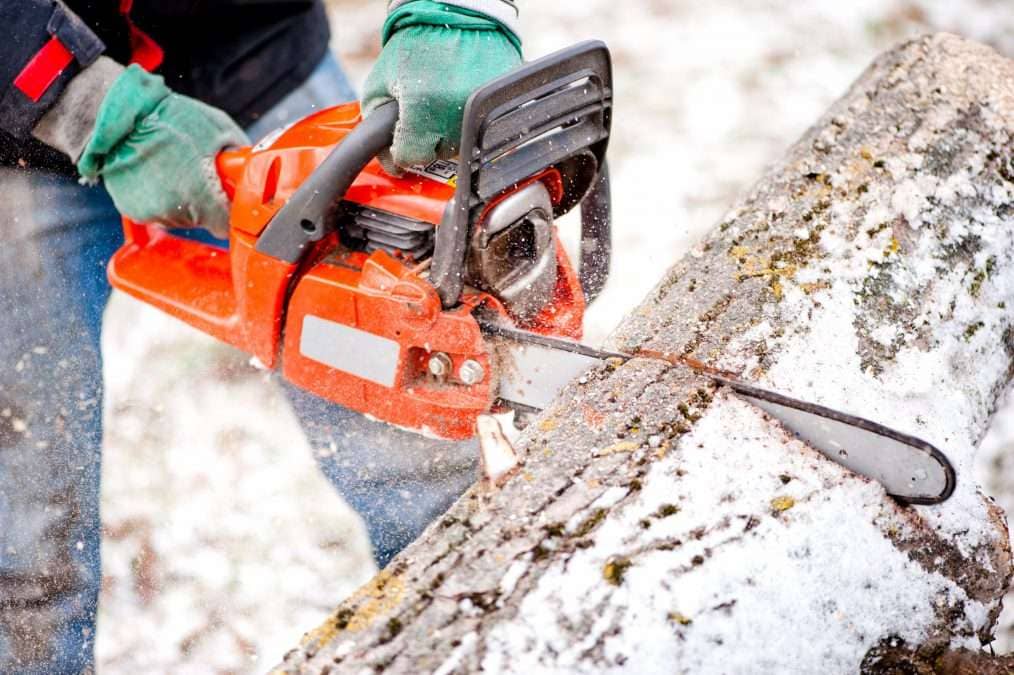
Removal means felling the whole tree. Note that stump grinding is a separate job with its own price — a removal quote does not automatically include it.
The decision at a glance
| What you are seeing | Usual call | Why |
|---|---|---|
| Scattered deadwood in an otherwise healthy canopy | Trim | Routine cleaning; the tree is sound |
| Branches over the roof, driveway or walkway | Trim (raising) | A clearance problem, not a health problem |
| Storm damage to under about a quarter of the branches | Trim | Likely to recover with corrective pruning |
| Crowded, rubbing or crossing limbs on a young tree | Trim (structural pruning) | Prevents costly defects later |
| Roughly half or more of the tree dead or damaged | Remove | Recovery is unlikely |
| Large cavity, or about a third of the interior hollow or rotten | Remove | Structural capacity is gone |
| Fungal conks growing on the trunk or root flare | Assess urgently, usually remove | Indicates internal decay |
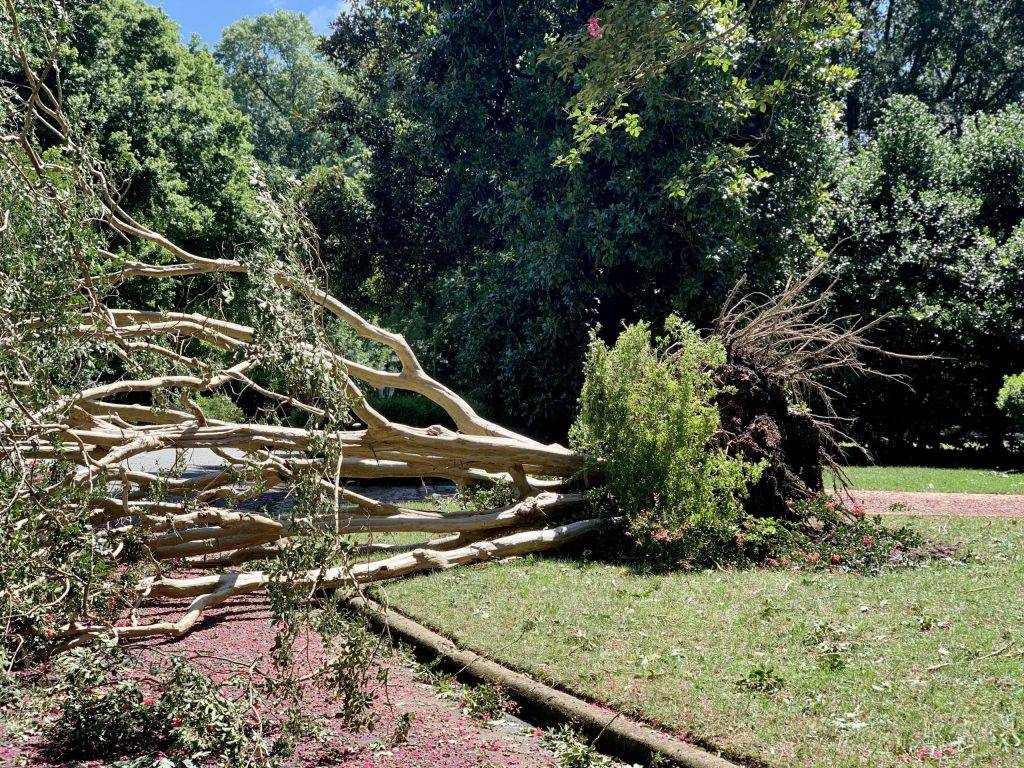
| A sudden new lean, or soil lifting on one side of the base | Remove promptly | Root anchorage has failed |
| Vertical trunk cracks or seams | Assess urgently | Potential trunk failure |
| Disease that will spread to neighboring trees | Remove | Protects the rest of the landscape |
| Wrong species in the wrong place, permanently conflicting | Remove and replant | Repeat pruning will never resolve it |
When removal is the right call
University of Maryland Extension publishes some of the clearest thresholds available, and they are worth knowing because most online advice simply asserts numbers:
- If 50% of the tree is damaged, it probably should be removed.
- If trunk damage covers less than 25% of the circumference, the wound may gradually close over.
- If about one third of the interior is hollow or rotten, it probably should be removed.
- If fewer than 25% of branches are damaged, the tree will probably survive.
- If 50% of the root system is damaged, it probably should be removed.
- A tree leaning more than 15% from vertical probably should be removed — and a sudden lean means roots have broken or weakened, which warrants immediate attention.
Treat these as arborist rules of thumb. An on-site assessment always overrides a number on a page, because the same defect matters enormously next to a bedroom and hardly at all in a back corner of a field. For a fuller walkthrough of the removal signs, see our guide on when to remove a tree, and on diagnosing decline, how to tell if a tree is dying.
When trimming is enough — and how much is too much
Pruning is the right answer when the tree’s trunk and roots are sound and the issue is confined to branches. But pruning is not free to the tree. ISA guidance is that no more than about 25% of the crown should be removed at one time, and less for mature trees, and that no branch should be removed without a reason, because every cut changes how the tree grows.
Young trees tolerate more removal than mature ones. Routine heavy thinning does not improve a tree’s health — it is a significant stress. If a tree genuinely needs a quarter of its canopy taken off every couple of years just to coexist with the house, that is usually a sign the species is wrong for the location.
Why topping is not a middle option
Topping — cutting branches back to stubs or to laterals too small to take over — is the most common homeowner attempt at a compromise, and it makes things worse. ISA is unambiguous: topping is not a viable method of height reduction and may increase risk in the long term.
It removes 50–100% of the leaf-bearing crown, which can starve the tree, and it forces weakly attached epicormic shoots that can grow as much as 20 feet in a single year and are prone to breaking in wind and ice. It creates wounds the tree cannot compartmentalize, inviting decay, and it commits you to repeat pruning within a few years. ISA also notes that damage caused by branch failure of a topped tree may support a finding of negligence in court.
ISA’s own stated alternative is telling: sometimes the best solution is to remove the tree and replace it with a species that is more appropriate for the site.
Is it cheaper to trim or remove?
Trimming costs less per visit; removal is a larger one-time cost. The figures below are 2026 national ranges from cost-aggregator data and vary widely with size, access, proximity to structures and local rates.
| Job | Typical range | Notes |
|---|---|---|
| Trimming, average per tree | $400–$900 | $80 for a small tree to $2,500+ for a large neglected one |
| Trimming by height | Under 30 ft: $250–$700 30–60 ft: $600–$1,200 60 ft+: $1,000–$2,500+ |
Minimum job fees often $100–$300 |
| Removal, typical | $385–$1,070 (average around $850) | Roughly $9.50–$14.50 per foot of height |
| Removal by height | Under 30 ft: $285–$435 30–60 ft: $435–$870 60–80 ft: $870–$1,160 80 ft+: $1,160–$2,000 |
Emergency removal $450–$3,000 |
| Stump grinding | $100–$525 | Separate line item, not included in removal |
| Debris hauling | $75–$250 | Confirm whether it is in the quote |
The honest framing: mature trees typically need trimming every three to five years, so the cheaper option recurs. Removal is once, plus the stump. But do not let a break-even calculation drive a safety decision, and do not let it drive a removal decision either — see the next section. For detail, see our tree removal cost and tree trimming cost guides.
What you give up by removing
Removal is irreversible, and that deserves weight. ISA notes that property values of landscaped homes run 5–20% higher than non-landscaped homes, that shade lowers cooling costs and windbreaks lower heating costs, and that in general the larger the tree, the greater the value.
ISA makes the economic point directly: the costs of large tree removal and replanting with a smaller tree can be significant, and the benefits produced by a young replacement are minimal compared with a mature specimen. Extending the functional lifespan of a large healthy tree through routine maintenance delays those expenses. If the tree can be kept safely, keeping it is usually the better deal.
There is also a middle ground most guides skip entirely: cabling and bracing for weak unions, crown reduction done properly, and root collar excavation can sometimes buy a valuable tree years of safe life. Ask about them before accepting a removal quote.
Timing: when to do the work
Light pruning of dead, diseased or weak limbs can be done at any time of year. Growth and wound closure are best before the spring flush, and heavy live-tissue pruning immediately after the flush is hardest on the tree. Maples and birches may bleed sap if pruned in early spring — unsightly, but harmless.
Oaks are the big exception. In oak wilt regions, University of Minnesota Extension advises not pruning oaks from April through July, because sap beetles carry the fungus to fresh wounds; November through February is the safe window. Michigan State Extension uses a wider April–October caution. The window varies by state, so check your state extension service. Importantly, this applies to felling oaks too, not just pruning — and unavoidable wounds and cut stump surfaces should be covered immediately with latex paint or shellac.
Removal driven by an actual hazard is not a seasonal decision. If a tree is unsafe, it comes down when it is identified.
Permits and the neighbor question
Many municipalities require a permit to remove a tree but not to trim it, and protected, heritage or landmark trees get the strictest treatment — some cities require approval even to prune them. Triggers are commonly trunk diameter, species, or a protected designation. There is no national rule, so check with your city or county planning or urban forestry department before removal, not after.
If the tree is on or near a boundary, the decision may not be yours alone. A tree whose trunk straddles the property line is typically jointly owned, and neither owner can remove it unilaterally. You can generally trim what overhangs your side up to the line, but you can be liable if the work kills the tree. See can I cut my neighbor’s branches over my yard and how to split tree removal cost with a neighbor.
When to bring in a certified arborist
Get a professional assessment when a defect sits near a target such as a house, driveway or play area; when a lean or crack has changed recently; when you need documentation of a known hazard for an insurer, a municipality or a neighbor; or when quotes differ wildly.
Ask for an ISA Certified Arborist, and for risk work specifically, one holding the Tree Risk Assessment Qualification (TRAQ) — a credential requiring training plus written and performance assessments, valid for seven years. Credentials can be checked through the ISA’s Verify a Credential tool. Any pruning that requires working above the ground or using power equipment should be done by a professional. See certified arborist cost and questions to ask before hiring a tree service.
Frequently asked questions
What is the difference between tree trimming and tree removal?
Trimming removes selected branches while keeping the tree; removal fells the entire tree. Trimming addresses clearance, deadwood and shape. Removal addresses defects in the trunk or roots, extensive dieback, or a hazard that pruning cannot resolve.
Is it cheaper to trim or remove a tree?
Trimming usually costs less per visit, commonly $400–$900 versus roughly $385–$1,070 for removal, but mature trees need trimming every three to five years. Removal is a one-time cost plus stump grinding. Costs vary widely by size, access and region.
Can trimming save a dying tree?
Sometimes. If the decline is confined to branches and the trunk and roots are sound, corrective pruning combined with addressing the underlying cause can help. If half the canopy is dead, or the trunk or root system is compromised, pruning will not reverse it.
How much of a tree can you remove without harming it?
ISA guidance is no more than about 25% of the crown at one time, and less for mature trees. Heavy pruning is a significant stress, and topping — which removes 50–100% of the crown — damages the tree and increases long-term risk.
Do I need a permit to remove a tree on my own property?
It depends entirely on your locality. Many cities require a permit for removal but not trimming, with triggers based on trunk diameter, species or a protected or heritage designation. Check with your local planning or urban forestry department first.
Is topping a good alternative to removal?
No. Topping increases long-term risk, starves the tree, produces weakly attached regrowth that breaks in storms, and commits you to repeat pruning. If height is a genuine problem, discuss proper crown reduction or removal and replacement with an appropriate species.
The bottom line
Look at where the problem is. If it is in the branches and the tree is otherwise sound, trim — and trim properly, not by topping. If the problem is in the trunk, the roots, or the sheer amount of the tree that has died, removal is the honest answer, and delaying it usually costs more than doing it. When you are genuinely unsure, an arborist assessment is the cheapest part of the whole decision.
This article is general information, not professional arboricultural, legal or insurance advice. Tree risk is site-specific and local rules vary. Have significant trees assessed on site by a qualified professional.

 Jack Turner