
Ash tree removal typically costs between $450 and $2,500, with most homeowners paying roughly $900 to $1,300 to take down an average-sized ash. Small ash trees under 30 feet can run as little as $250 to $550, while removing a large, mature ash of 70 feet or more often reaches $2,000 to $3,600 or higher. Price depends mainly on the tree’s size, its condition, and how easy it is to reach.
Ash trees carry one cost driver that most other hardwoods do not: the emerald ash borer (EAB). This invasive beetle has killed hundreds of millions of ash trees across North America, and a dead, borer-infested ash becomes brittle and dangerous to climb, often forcing crews to bring in a crane or bucket truck. That safety premium is the single biggest reason ash removal can cost more than removing a comparable oak or maple. For a broader breakdown of what tree work costs, see our complete tree removal cost guide.
How much does ash tree removal cost?
The average cost to remove an ash tree is about $900 to $1,300 nationwide, though the full range spans roughly $250 for a small, easy-access tree to $3,600+ for a very large or hazardous one. Because pricing is driven by size and risk, the same crew may quote very different numbers for two ash trees on the same street. Always get two or three written estimates, since prices vary by region, tree condition, and access.
Crews usually price by a combination of height and trunk diameter (measured as DBH, or diameter at breast height). A tall ash with a thick trunk near a house will always cost more than a slender one in an open field.
Ash tree removal cost by size
Size is the biggest single factor. The table below shows typical 2026 price ranges for a standard, healthy ash in good access conditions. Dead or hard-to-reach trees fall at the higher end or above.
| Ash tree size | Approx. height | Typical removal cost |
|---|---|---|
| Small | Under 30 ft | $250 – $550 |
| Medium | 30 – 50 ft | $500 – $1,200 |
| Large | 50 – 70 ft | $1,100 – $2,200 |
| Very large / mature | 70 ft and up | $2,000 – $3,600+ |
For a side-by-side look at how height and trunk width change the price of any species, see our tree removal cost by size guide, or run the numbers with our tree removal cost calculator.
What affects ash tree removal cost?
Beyond size, several factors move the final quote up or down:
- Health and EAB damage: A dead, brittle ash is more dangerous and usually costs 25% to 50% more to remove safely than a live one of the same size.
- Location and access: Trees in tight backyards, over fences, or far from the street take longer and cost more than trees a truck can pull right up to.
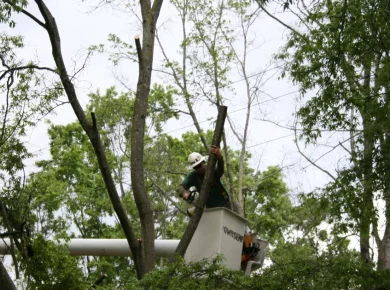
- Proximity to structures and power lines: An ash leaning over a roof or near utility lines often needs a crane, rigging, or a line clearance crew, which raises the price.
- Crane requirement: Crane-assisted removal of a large or unstable ash can add several hundred to a few thousand dollars.
- Stump grinding: Removing the stump is almost always billed separately.
- Debris and log hauling: Hauling away wood and chips may cost extra, though some homeowners keep the wood to offset the bill.
- Permits: Some cities require a permit to remove a tree above a certain size, even on private property.
- Emergency timing: Same-day or post-storm removal carries a premium over scheduled work.
The emerald ash borer factor: why dead ash costs more
The emerald ash borer is a metallic-green beetle whose larvae tunnel just under the bark, cutting off the tree’s ability to move water and nutrients. Infested ash trees usually die within two to four years, and once dead, ash wood dries out and becomes unusually brittle. Standing dead ash can shed large limbs without warning, which makes climbing them hazardous.
Because of that danger, many tree services will not climb a dead ash and instead remove it from a bucket truck or with a crane, dropping sections that would normally be climbed and lowered by hand. That equipment and the extra safety planning are why removing a borer-killed ash routinely costs more than the size table alone would suggest. If you are unsure whether your ash is declining, our guide on how to tell if a tree is dying walks through the warning signs, and dead tree removal cost covers the pricing in detail. You can confirm whether EAB is active in your area through the USDA APHIS emerald ash borer program.
Treatment vs. removal: which is cheaper?
If an ash is still relatively healthy, treating it for EAB can be cheaper than removal over the short term, but the math changes as the tree declines. Treatment is an ongoing cost repeated every one to two years for the life of the tree, while removal is a one-time expense.
| Option | Typical cost | Best when |
|---|---|---|
| EAB treatment (trunk injection) | ~$7 – $16 per DBH inch per cycle (about $100 – $500 each treatment) | Tree is healthy with less than roughly 30% canopy loss and is worth saving for shade or value |
| Removal + stump grinding | $450 – $3,600+ | Tree is dead, has major dieback, or is structurally unsafe |
| Removal + replanting | Removal cost plus $150 – $500 for a new tree | You want a healthier, borer-resistant species long term |
A certified arborist can assess the canopy and tell you whether treatment is still worthwhile. Guidance from the International Society of Arboriculture recommends treating only trees that are still in good condition and located where a full-grown tree adds real value.
Additional costs to budget for
The removal quote is rarely the whole story. Common add-ons include:
- Stump grinding: $100 – $400, or roughly $2 – $5 per inch of stump diameter. See stump grinding cost for details.
- Log and debris hauling: $50 – $150 if you do not keep the wood.
- Crane service: Often bundled into large-tree quotes; standalone crane fees run higher. See crane tree removal cost.
- Permit fees: $0 – $150+ depending on your city or HOA.
- Replacement tree and planting: $150 – $500+.
How to save money on ash tree removal
- Get multiple written quotes. Prices for the same ash can vary widely between companies.
- Bundle jobs. Removing several trees at once, or adding stump grinding to the same visit, usually lowers the per-tree price.
- Schedule in the off-season. Late fall and winter are often slower and cheaper for tree crews.
- Keep the wood. Asking the crew to leave logs or chips can trim hauling fees.
- Do not wait too long. A dead ash only gets more brittle and more expensive to remove safely over time.
Frequently asked questions
Why is ash tree removal more expensive than other trees?
Ash removal often costs more because emerald ash borer damage leaves the wood brittle and unsafe to climb, so crews use cranes or bucket trucks and extra rigging. That equipment and the added safety planning raise the price above a comparable oak or maple.
How much does it cost to remove a dead ash tree?
A dead ash usually costs 25% to 50% more than a live one of the same size, so a medium dead ash that might run $500 to $1,200 alive can reach $1,500 to $2,000 or more once crane work is factored in.
Should I treat or remove my ash tree?
Treatment makes financial sense mainly for healthy ash trees with less than about 30% canopy loss that are worth saving. Once a tree shows major dieback or is dead, removal is safer and, over time, cheaper than repeated treatments.
Does homeowners insurance cover ash tree removal?
Insurance generally does not pay to remove a standing dead or borer-killed ash, since that is considered routine maintenance. Coverage usually applies only if the tree falls and damages an insured structure. Policies vary, so check your specific coverage.
Do I need a permit to remove an ash tree?
It depends on your city and whether the tree exceeds a protected size. Many municipalities require a permit for larger trees even on private property, so confirm local rules before scheduling work.
Cost figures here are general 2026 estimates and will vary by region, tree condition, and access. Always get written quotes from licensed, insured tree services for your specific situation.

 Jack Turner