
For most homeowners, tree removal on a personal residence is not tax deductible — the IRS treats it as a nondeductible personal expense, the same as mowing the lawn or repainting a fence. But there are real exceptions. Tree removal can be deductible when the tree is on a rental or business property, when it qualifies as a casualty loss after a federally declared disaster, when part of your home is a qualified home office, or when the work adds to your property’s cost basis.
Below is a plain-English breakdown of when tree removal is and isn’t deductible, how the rules differ for rentals versus your own home, and what records you need. Tax rules are complex and change, so treat this as a starting point and confirm your situation with a licensed tax professional.
Is tree removal tax deductible? Quick answer
Tree removal is deductible only in specific circumstances. On your own home it is generally a personal expense with no deduction, unless it ties to a home office, a federally declared disaster, or a capital improvement that raises your cost basis. On property you rent out or use for business, removal is usually deductible — either as a repair in the year you pay for it or as a capital cost you recover over time.
| Situation | Deductible? | How it’s treated |
|---|---|---|
| Removal from your personal residence (routine) | No | Nondeductible personal expense |
| Rental or business property | Often yes | Repair expense, or capitalized improvement |
| Casualty loss (federally declared disaster) | Sometimes | Personal casualty loss on Form 4684 |
| Qualified home office | Partially | Deduct the business-use percentage |
| Capital improvement to your home | Not now, but later | Added to cost basis; reduces gain at sale |
Removing a tree from your own home
If you remove a dead, damaged, or unwanted tree from the yard of your primary residence for ordinary reasons — it’s an eyesore, it’s dropping limbs, you want more sun — the cost is a personal expense and is not deductible. This is the situation most homeowners are in. Knowing the typical price still helps you budget and compare bids; see our guides to tree removal cost and how much it costs to cut down a tree.
There are two ways even a personal-home removal can matter at tax time: as part of a capital improvement that adds to your basis, or as a casualty loss after a qualifying disaster. Both are covered below.
Rental and business property: usually deductible
Trees on income-producing property follow business-expense rules, which are far more favorable. If you own a rental home or use a property in a trade or business, tree removal is generally deductible — the key question is whether it’s a repair or an improvement.
Repair vs. improvement
A repair keeps the property in ordinary working condition — for example, taking down a dead or storm-damaged tree that threatens the rental. Repairs are typically deducted in full in the year you pay them. An improvement betters the property, adapts it to a new use, or is part of a larger upgrade — for example, clearing trees to add a parking pad or build an addition. Improvements are capitalized and recovered over time through depreciation or added to basis rather than deducted all at once.
- Likely a repair (deduct now): removing a single hazardous, dead, or diseased tree to maintain the property.
- Likely an improvement (capitalize): clearing multiple trees as part of new construction, grading, or a landscaping upgrade.
The IRS guidance for landlords is laid out in IRS Publication 527, Residential Rental Property. Because the repair-versus-improvement line is fact-specific, this is a good area to run past your accountant.
If you legitimately use part of your home regularly and exclusively for business and claim a home-office deduction, you may be able to deduct a portion of a tree removal as an indirect expense. The deductible share generally matches the percentage of your home used for business — so if your office is 12% of your home’s square footage, roughly 12% of a qualifying whole-property expense could apply. The simplified home-office method uses a flat rate instead and would not add a separate line for tree removal, so the method you use matters.
Casualty loss after a federally declared disaster
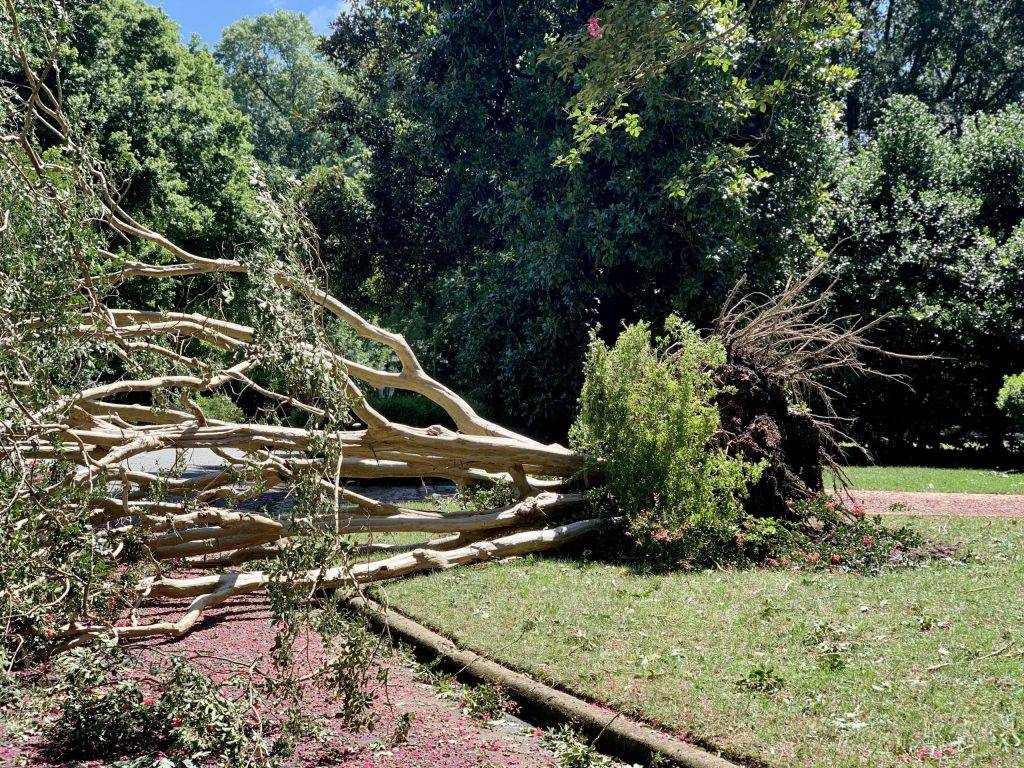
When a storm, fire, hurricane, tornado, or similar sudden event damages or destroys a tree, the cleanup and any drop in your property’s value may qualify as a casualty loss. For tax years 2018 through 2025, personal casualty losses are deductible only if they result from a federally declared disaster — everyday storm damage that isn’t part of a declared disaster does not qualify for personal property. Business and income property losses follow separate, broader rules.
Casualty losses are figured on IRS Form 4684 and explained in IRS Publication 547, Casualties, Disasters, and Thefts. The deductible amount is based on the decrease in your property’s fair market value (not just the removal bill), reduced by insurance reimbursements and statutory limits. University extension programs, such as the Mississippi State University Extension, publish helpful primers on valuing landscape-tree losses. If the tree came down in a storm, our overview of emergency tree removal cost shows what that urgent work typically runs.
Capital improvements and your cost basis
Even when a removal isn’t deductible today, it can still lower your taxes later. If tree work is part of a capital improvement — say, clearing land to build an addition or a new driveway — the cost can be added to your home’s cost basis. A higher basis reduces your taxable gain when you eventually sell, as described in IRS Publication 523, Selling Your Home. Keep the receipts; they may be worth real money years down the road.
What records to keep
Whatever category you fall into, documentation is what makes a deduction defensible. Hold onto:
- Itemized invoices and proof of payment from the tree service.
- Before-and-after photos, especially for storm or disaster damage.
- Insurance claim paperwork and any reimbursement amounts.
- For disasters, the FEMA declaration number for your area.
- For rentals, notes on why the work was a repair versus an improvement.
A written tree removal estimate and the final itemized bill together create a clean paper trail.
Frequently asked questions
Can I deduct tree removal on my primary home?
Generally no. Routine removal from a personal residence is a nondeductible personal expense. It can matter for taxes only if it’s part of a capital improvement (added to basis) or a casualty loss from a federally declared disaster.
Is tree removal deductible on a rental property?
Usually yes. Removing a hazardous or dead tree to maintain a rental is typically a deductible repair in the year you pay it. If the work is part of a larger upgrade, it may have to be capitalized instead.
Does insurance affect the deduction?
Yes. Any insurance reimbursement reduces the loss you can claim. You generally can’t deduct a cost that your insurer paid back to you, and casualty-loss math starts from your unreimbursed loss.
Is storm tree removal always a casualty loss?
No. For personal property in 2018–2025, the damage must stem from a federally declared disaster to qualify. Ordinary storm damage outside a declared disaster is not a deductible personal casualty loss, though rules differ for business property.
Can tree removal ever count as a medical expense?
Rarely. In unusual cases where a physician documents that removal is medically necessary (for example, a severe, verified allergy), part of the cost might qualify as a medical expense. This is uncommon and should only be claimed with professional tax and medical documentation.
Disclaimer: This article is general information, not tax or legal advice, and tax laws change frequently and vary by state and situation. Consult a licensed CPA or tax professional and refer to current IRS guidance before claiming any deduction.


 Jack Turner