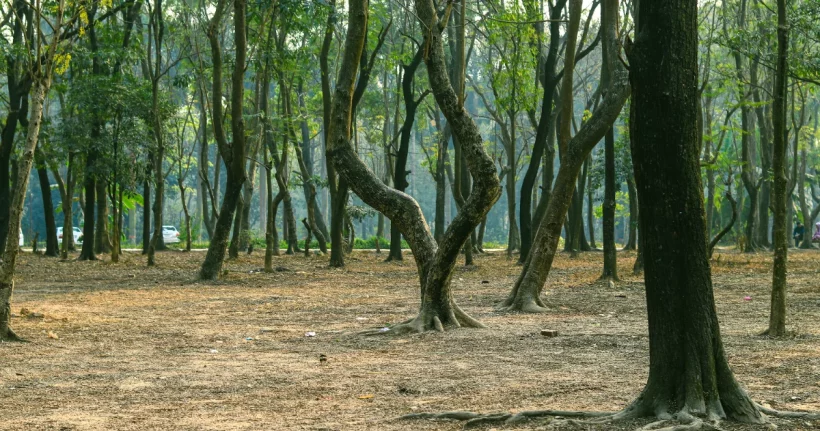

Tree roots can damage a house foundation, but usually not the way people imagine. In most cases the roots are not prying the concrete apart. They are drying out the soil underneath it. In shrink-swell clay, that loss of moisture causes the ground to contract, the footing loses support, and the house settles unevenly.
That distinction matters, because it changes the fix. If you think roots are cracking your foundation, you cut the roots. If the real problem is soil moisture swinging between bone-dry and saturated, cutting roots may not solve anything — and removing the tree can make it worse before it gets better. Here is how to tell what is actually happening under your house, and what to do about it.
Do tree roots actually damage foundations?
Yes, but rarely by force. Tree roots do not generate enough pressure to fracture sound concrete. They are opportunistic: they grow where growth is easiest, and when they meet a solid, impervious surface they are redirected sideways or up and over it. Where a crack or joint already exists, roots will grow into that opening and can widen it over time.
Purdue University Extension puts it plainly: roots damage a foundation “with an invitation to do so.” The same principle explains sewer lines — roots do not break intact pipes, they find existing leaks and move in. If you are dealing with slow drains rather than wall cracks, that is a plumbing problem, and our guide to tree roots in a sewer line covers it in detail.
How tree roots damage a foundation: three mechanisms
1. Soil moisture change in clay (the main one)
Trees move large volumes of water. When roots draw moisture out of expansive clay soil beside or beneath a footing, that clay shrinks and support is lost under part of the house. When wet weather returns, the clay re-swells and heaves. Repeat that cycle for a few seasons and you get differential settlement — one part of the foundation moving relative to another, which is what actually cracks masonry and racks door frames.
The Virginia Department of Energy geological survey names this directly, noting that conditions such as rerouted drainage, leaking pipes, downspouts, or the presence of large trees can locally affect soil moisture and increase the shrink-swell behavior of expansive soils.
2. Roots exploiting an existing crack
Where a foundation wall already has a breach, roots can follow the moisture in and thicken inside the gap. This is real, but it is almost always a secondary problem — the crack came first.
3. Direct uplift of thin slabs
Roots genuinely do lift sidewalks, patios and driveways, because that flatwork is thin and unreinforced. This is not the same as structural foundation damage. If that is your situation, see tree roots under a driveway.
Which soils and regions are most at risk
The culprit is expansive clay, mainly the mineral montmorillonite, which can swell to many times its dry volume. The Colorado Geological Survey notes that expansive soils cause annual losses in the United States regularly estimated to exceed those of tornadoes, floods, earthquakes and hurricanes combined.
One nuance most articles miss: it is the swing in soil moisture that does the damage, not simply the presence of clay. Semi-arid regions with sharp wet-dry seasonal cycles see far more expansion problems than consistently wetter areas. Commonly identified high-risk areas include Texas and the Gulf and South Central states, the Great Plains and Colorado Front Range, the arid Southwest, parts of California, and clay belts through the Southeast and mid-Atlantic.
You can look up your own property’s soil in the USDA NRCS Web Soil Survey rather than guessing.
Signs tree roots may be damaging your foundation
The tell-tale pattern is differential settlement concentrated on the tree side of the house. Watch for:
- Doors and windows sticking, or reveal gaps that are wider at one end
- Diagonal cracks radiating from the corners of door and window openings
- Stair-step cracks following the mortar joints in brick or block
- Cracks running the full width of a slab floor
- Sloping or uneven floors — a marble that consistently rolls one way
- Gaps opening where walls meet ceilings or floors; moldings pulling apart
- A chimney or porch leaning away from the house
- Damage clustered on one side of the building rather than spread evenly
Is it the tree, or something else?
This is the question almost no one answers, and getting it wrong is expensive. Different causes leave different signatures:
| What you see | Likely cause | What it means |
|---|---|---|
| Cracks widen in late summer or drought, partly close after sustained rain | Soil moisture change (often tree-driven) | Seasonal and reversible; address moisture and the tree |
| Horizontal cracks with basement walls bowing inward | Lateral soil or hydrostatic pressure | Not a root problem. Call a structural engineer now |
| Fine vertical cracks in newer concrete, not progressing | Curing shrinkage | Usually cosmetic |
| Localized settlement with damp soil or a persistent wet spot | Plumbing leak softening soil | Find and fix the leak first |
| Slow drains and recurring backups | Root intrusion into a leaking sewer lateral | A plumbing issue, not a foundation one |
| Heave in winter, shallow groundwater, silty soil | Frost heave | Distinct mechanism from expansive clay |
| Only the walkway or patio is lifted, root visible beneath | Direct root uplift of thin flatwork | Not structural |
The seasonal test: because moisture-driven movement is cyclical, date-mark and photograph the ends of each crack, then measure the width monthly for a full year. Movement that opens in drought and closes after wet weather points to soil moisture. Damage that only ever gets worse points to something structural.
How far should trees be from a foundation?
There is no single correct number — it depends on mature size, species, soil and foundation type. These are published extension guidelines:
| Mature tree size | Suggested minimum distance from a wall |
|---|---|
| Small (under about 30 ft) | 8–10 ft |
| Medium (about 30–40 ft) | 15 ft |
| Large (40 ft and over) | 20 ft minimum |
| Strong-wooded shade trees such as oaks | No closer than 20 ft |
| Soft-wooded trees such as soft maple | Greater than 20 ft |
Mississippi State University Extension notes that tree roots extend at least 1.5 times the crown diameter, and up to 5 times in dry areas. That is why the edge of the canopy is not a safe boundary. In expansive clay, add margin.
Which trees are highest risk near a house?
Species commonly flagged by arborists and extension services as high risk near structures share three traits: fast growth, shallow wide-spreading lateral roots, and high water demand. They include weeping willow, hybrid poplar and cottonwood, silver and Norway maple, American elm, large oaks, ash, sycamore, sweetgum, boxelder and black locust.
Lower-risk choices near a foundation include eastern redbud, flowering dogwood, serviceberry, crabapple, star magnolia, Japanese maple, crape myrtle and hawthorn.
Fixes and what they typically cost
Cost figures below are national ranges drawn from contractor and cost-aggregator data. They vary widely by region, access, soil and severity — treat them as a starting point, not a quote.
| Option | Typical US range | When it makes sense |
|---|---|---|
| Grading and downspout correction | Often a few hundred dollars | Always first — cheapest meaningful fix |
| Root barrier installation | About $60–$75 per linear foot; roughly $1,000–$5,000 per project | Preventing regrowth toward the structure |
| Root pruning by an arborist | Quote locally; varies too much for a national figure | Specific roots identified near the footing |
| Slab jacking / foam injection | About $500–$1,300 typical | Sunken slab sections |
| Piering / underpinning | Roughly $1,400–$3,200 per pier; typical jobs $5,000–$15,000 | Confirmed structural settlement |
| Tree removal | See our tree removal cost guide | When the tree is the ongoing driver |
Two cautions. First, root pruning can destabilize a tree. The large roots near the trunk are the structural root plate that anchors it. Bartlett Tree Research Laboratories advises avoiding cuts to roots over 3 inches in diameter where possible, keeping cuts at least 5 to 6 times the trunk diameter away from the trunk (3 times if cutting on one side only), and performing a risk assessment before cutting any roots at all. Cuts closer than that can dramatically compromise stability.
Second, removing the tree does not undo existing damage and in expansive clay it can trigger rebound heave as the soil re-wets and swells. Get the foundation assessed either way. If you are weighing this decision, our comparison of when to remove a tree may help.
Arborist or structural engineer?
Call an arborist when the question is about the tree: is it healthy, which roots are involved, can they be cut safely, would a root barrier or crown reduction help. Look for an ISA Certified Arborist. Our guide to certified arborist cost covers what to expect.
Call a structural engineer when the question is about the building: cracks wider than about a quarter inch, cracks that are actively widening, horizontal cracks or bowing walls, noticeably sloping floors, or wildly divergent contractor estimates. An engineer is independent of the repair sale and produces the specification a contractor then executes. Insurers frequently require an engineer’s report.
What if it is your neighbor’s tree?
In most US states you may cut roots and branches that encroach onto your property, but only up to the boundary line — and you can be held liable if your cutting kills or destabilizes the tree. Because root pruning near a trunk genuinely can kill a tree, this is the situation where a written arborist opinion before you cut is worth far more than it costs. Rules vary by state. See neighbor’s tree roots in my yard and our detailed guide to a neighbor’s tree roots damaging your foundation or pipes.
- Match species to distance when planting, using the table above. Small ornamentals within 10–15 ft of the house; large shade trees well beyond 20 ft.
- Install a root barrier at planting time, not as a retrofit. Far cheaper and far less damaging to the tree.
- Manage moisture for stability, not saturation. Keep grading and downspouts carrying water away from the foundation, while avoiding letting perimeter soil swing between bone-dry and soaked.
- Do not plant large trees over sewer laterals, and replace failing clay or cast-iron lines.
- Protect roots during construction. Trenching, grading, paving and soil compaction inside the critical root zone stress a tree, and a stressed tree forages harder for water.
Frequently asked questions
Can tree roots break through a concrete foundation?
Not through sound concrete. Roots lack the force to fracture intact foundation walls or footings. They exploit cracks and joints that already exist, and they can widen those openings over time. If a foundation is cracking near a tree, soil movement is the more likely cause.
Will removing the tree fix my foundation?
It stops further moisture withdrawal, but it does not repair damage that has already occurred. In expansive clay, removal can cause the soil to re-wet and swell, producing heave. Have the foundation assessed before and after.
Does homeowners insurance cover this?
Usually not. Standard homeowners policies generally exclude damage from expansive or compressive soils and from frost heave. Read your own policy and speak to your insurer — coverage varies.
Can I cut tree roots near my foundation myself?
Small roots under about an inch, sometimes. Anything larger risks both the tree’s health and its stability, and a destabilized tree near a house is a bigger hazard than the original problem. Get an arborist to assess before cutting.
How close is too close for a tree to a house?
As a working rule, small trees no nearer than 8–10 ft, medium trees 15 ft, and large shade trees at least 20 ft from a wall. In expansive clay soils, increase those distances.
Do root barriers actually work?
Yes, when installed correctly — vertically, deep enough to intercept the shallow root zone, and positioned between the tree and the structure. They redirect roots rather than kill them, so placement and depth matter more than material.
The bottom line
Before you cut a root or remove a tree, work out whether you have a moisture problem or a structural one. Document the cracks, watch them through a full wet and dry cycle, check your soil type, and get the tree looked at by a certified arborist and the building looked at by a structural engineer. Those two opinions cost far less than the wrong repair.
This article is general information, not engineering, legal or insurance advice. Foundation behavior is site-specific, and costs and legal rules vary by state and locality. Consult qualified local professionals about your property.


 Jack Turner