
If your driveway is buckling, cracking, or rising in one spot, tree roots underneath are a likely culprit — and you usually have options short of tearing out the tree. The right fix depends on how big the roots are, how much damage has been done, and how much you value the tree.
Short answer: Small feeder roots (under about 1 inch thick) can often be cut and the slab repaired, and a root barrier can keep new roots away for the long term. Large structural roots should not be cut — removing them can kill or topple the tree — so those cases may call for bridging the driveway or, as a last resort, removing the tree.
Why tree roots damage driveways
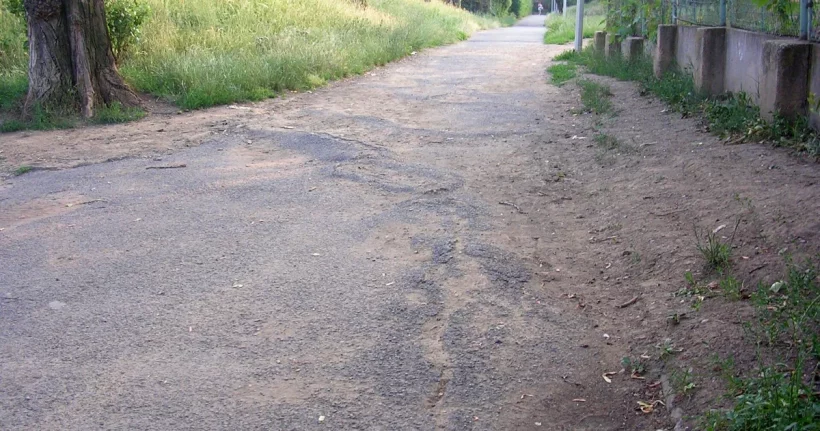
Most of a tree’s roots grow in the top 12 to 24 inches of soil, spreading well beyond the canopy in search of water and oxygen — often far under a driveway. As those roots grow in diameter year after year, they exert enormous upward and sideways pressure on whatever sits above them. Concrete and asphalt can’t flex, so they crack, heave, and lift.
Driveways are especially attractive to roots because the soil beneath them stays moist and loose, and the pavement traps a little extra moisture. That’s why the damage tends to concentrate near large, thirsty species planted close to the slab.
Signs tree roots are the cause
- Cracks or lifting that radiate from the side nearest a tree.
- A raised hump or ridge that follows the line of a root.
- Damage that worsens over seasons rather than after a single freeze.
- Visible surface roots nearby, or roots found when you probe the crack.
Repair options, compared
There is no single right answer — it’s a trade-off between cost, how long the fix lasts, and whether you keep the tree. Here’s how the main options compare. Costs are broad national ranges and vary by region, size, and access.
| Option | Best when | Keeps the tree? | Typical cost |
|---|---|---|---|
| Cut small roots + patch or replace the section | Roots are under ~1 inch; damage is localized | Usually yes | $300–$1,500 |
| Install a root barrier | You want to stop future damage without removal | Yes | $200–$1,200 |
| Grind, level, or mudjack the slab | Minor lifting, no need to cut roots | Yes | $500–$1,500 |
| Bridge or ramp over large roots | Roots are structural and can’t be cut | Yes | $1,000–$3,000+ |
| Full section replacement | Extensive cracking across the driveway | Depends | $1,500–$5,000+ |
| Remove the tree, then repave | Tree is unhealthy, poorly placed, or damage is severe | No | $200–$2,000+ to remove, plus repaving |
For current removal figures, see our guide to tree removal cost.
Can you cut tree roots under a driveway safely?
Sometimes — but carefully. As a rule of thumb, it is usually safe to cut feeder roots less than about 1 inch in diameter. Larger, woody structural roots anchor the tree and feed it; cutting them can starve the tree, invite decay, or leave it unstable enough to fall. Arborists generally advise never removing more than roughly a quarter of a tree’s root system, and never cutting large roots inside the critical root zone close to the trunk.
Two safe guidelines before you dig:
- Keep your distance from the trunk. The closer to the trunk, the more important the root — and the more dangerous it is to cut.
- When in doubt, call a professional. A certified arborist can tell you which roots are safe to sever and whether the tree will survive.
If your goal is also to keep roots away from pipes or structures, our guides on how to stop tree roots from growing and tree roots in a sewer line cover the same principles.
Root barriers: the best long-term fix
If you want to keep the tree and stop the damage from coming back, a root barrier is usually the most effective solution. A barrier is a rigid underground panel — typically HDPE plastic, fiberglass, or metal — installed in a trench between the tree and the driveway. It redirects roots downward and away instead of under the slab.
Barriers work best installed before a tree gets large, but they can still help around an established tree if placed carefully to avoid cutting major roots. HDPE barriers can last 50 years or more underground. Pair a barrier with a repair to the existing damage and you’ve solved both the symptom and the cause.
What if it’s a neighbor’s tree?
When the offending tree belongs to a neighbor but its roots have crept under your driveway, most states follow the “self-help” rule: you may remove roots that have crossed onto your property, at your own expense, as long as you stay on your side of the line and don’t kill or destabilize the tree. If you damage the tree, you can be held liable — sometimes for multiples of its value.
Talk to your neighbor first, and see our guide on a neighbor’s tree roots in your yard for how responsibility and cost-sharing typically work.
How to prevent driveway root damage
- Plant the right tree in the right place. Keep large species well back from pavement; see how close to a property line you can plant a tree for spacing guidance.
- Choose non-aggressive species near driveways — avoid willows, silver maples, poplars, and elms close to slabs.
- Install a root barrier at planting time.
- Use flexible paving (asphalt, pavers, resin-bound gravel) where roots are unavoidable, so the surface can ramp over minor heaving.
Frequently asked questions
Will cutting the roots kill my tree?
It can, if you cut large structural roots or remove too many. Cutting small feeder roots (under ~1 inch) and staying away from the trunk is usually safe. When large roots are involved, have an arborist assess the tree first.
Should I just remove the tree?
Only as a last resort — when the tree is unhealthy, badly placed, or the damage is severe and recurring. A healthy, well-placed tree adds value and shade, so bridging or a root barrier is often the smarter fix.
How do I stop the damage from coming back after I repair the driveway?
Install a root barrier between the tree and the driveway when you make the repair. Without one, new roots can eventually follow the same path.
Can I pour concrete right over the roots?
You can bridge over them with a reinforced slab, but pouring directly onto growing roots without addressing them usually just cracks again. Cut small roots or bridge structurally, then repave.
Who pays if a neighbor’s tree roots damaged my driveway?
Usually you do, unless you can show the neighbor was negligent. You can remove the encroaching roots yourself under the self-help rule, but keep the tree healthy to avoid liability.
This article is general information, not professional arboricultural or legal advice. Have a certified arborist evaluate root cutting on a mature tree, and check local rules before major work.
Lifted flatwork is not the same as structural damage. For what happens when roots affect the house itself, see tree roots damaging a foundation.

 Jack Turner