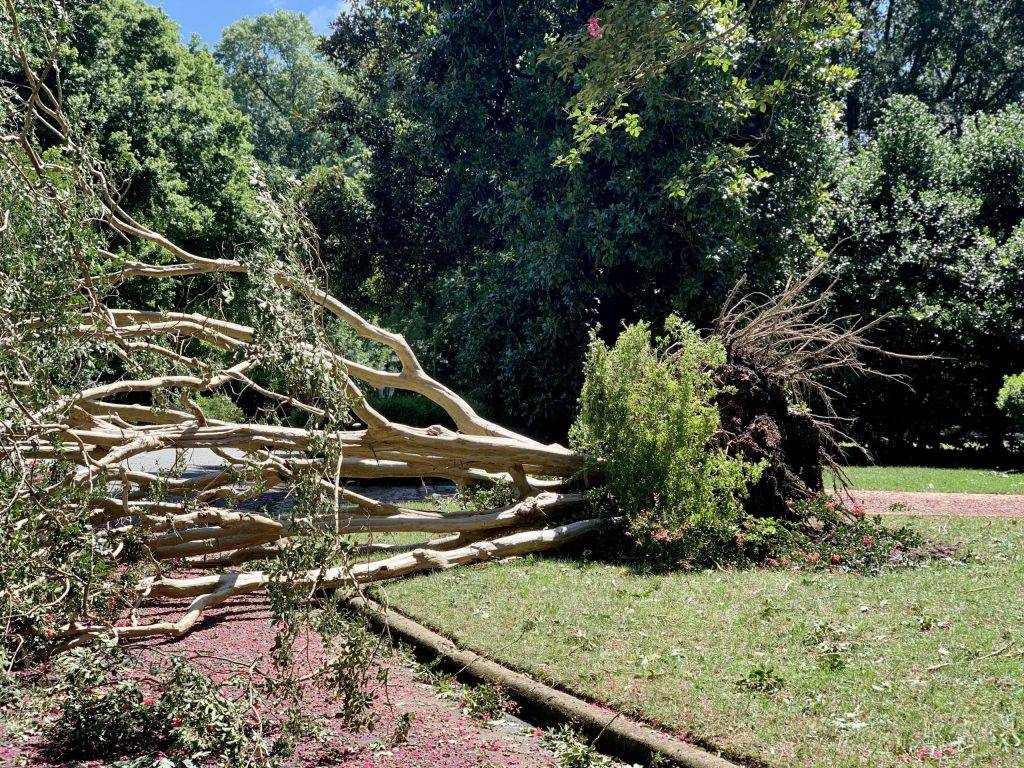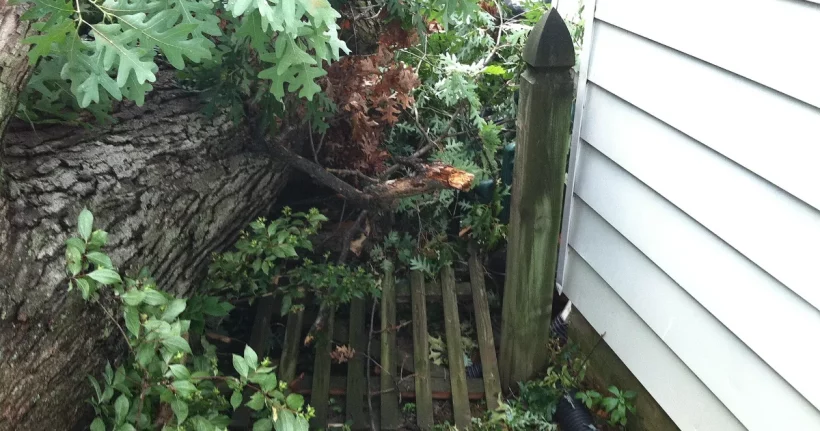

When a neighbor’s tree falls on your fence, you usually file the claim with your own homeowners insurance first. Insurers treat a healthy tree knocked down by wind or a storm as an “act of nature” that is nobody’s fault, so each owner’s policy covers the damage on their own property. Your neighbor (and their insurer) typically pays only if you can show the tree was already dead, diseased, or visibly dangerous and they knew or should have known about it — in other words, if they were negligent.
If the owner was negligent and will not pay, a demand letter for tree damage is the standard next step before small claims.
That single distinction — act of nature versus negligence — decides almost every fallen-tree fence dispute. Below is a plain-English guide to who pays, how the insurance actually works, and exactly what to do in the first 48 hours.
Who pays when a neighbor’s tree falls on your fence?
The short answer: the owner of the damaged property files the claim, not the owner of the tree. Because the fence is yours, your policy’s “other structures” coverage handles it. The exception is provable negligence, which can shift the bill to your neighbor. This table covers the common scenarios.
| Situation | Who typically pays | Why |
|---|---|---|
| Healthy tree falls in a storm or high wind | Your own insurance (your deductible applies) | Treated as an act of nature; no one is at fault |
| Tree was dead, diseased, or leaning and the neighbor was warned | Neighbor’s liability insurance | Negligence — they failed to remove a known hazard |
| You have no proof the tree was unhealthy | Your own insurance | Negligence cannot be shown |
| Damage is less than your deductible | You, out of pocket (or pursue the neighbor) | A claim would pay nothing after the deductible |
| Fence sits exactly on the property line (shared fence) | Often split between both owners | Both parties typically share boundary-fence costs |
Amounts vary widely by state, policy, and the condition of the tree, so use this as a starting point rather than a guarantee.
The “act of nature” rule explained
An “act of nature” (sometimes called an “act of God”) is an event no person caused or could reasonably prevent — a storm, lightning strike, or sudden gust that brings down an otherwise healthy tree. When that happens, insurance companies generally hold each property owner responsible for damage on their own land, regardless of where the tree grew. So even though it was your neighbor’s tree, your fence is your loss to claim.
This rule frustrates a lot of homeowners, but it exists because a healthy tree falling in a storm is genuinely no one’s fault. The law does not make your neighbor an insurer of every tree on their lot.
When your neighbor is liable (negligence)
Your neighbor — and therefore their insurance — may be on the hook if the tree was a known hazard. To establish negligence, you generally need to show the tree was dead, diseased, structurally unsound, or dangerously leaning before it fell, and that your neighbor knew or reasonably should have known.
Evidence that helps prove negligence includes:
- Photos or video showing the tree was dead, hollow, fungus-covered, or leaning before the fall.
- A prior written warning — a text, email, or letter you sent asking them to address the tree.
- An arborist’s report documenting decay or instability.
- A municipal notice or inspection flagging the tree as hazardous.
- Statements from other neighbors who also raised concerns.
This is why a paper trail matters. If you are worried about a neighbor’s tree right now, send a dated, polite written notice — our letter to a neighbor about a dead tree template gives you the wording. That single document can be the difference between their insurer paying and yours.
What to do right after a tree falls on your fence
Move through these steps in order. The first hours are when most useful evidence either gets captured or lost.
- Make sure everyone is safe. Stay clear of downed power lines and call your utility if any wires are involved.
- Photograph everything before you move it — the tree, the fence, the broken stump or root ball, and any visible signs of rot or disease.
- Prevent further damage, but don’t make permanent repairs yet. Tarps or temporary bracing are fine and usually reimbursable.
- Contact your homeowners insurer to open a claim and ask how “other structures” coverage applies to your fence.
- Notify your neighbor in writing, calmly. If you believe the tree was already unhealthy, say so and keep a copy.
- Get a removal quote. See typical pricing in our guide to the cost to remove a fallen tree.
- Keep every receipt for cleanup, temporary repairs, and the eventual fence rebuild.
How fence insurance claims actually work
Fences fall under the “other structures” portion of a standard homeowners policy — the same category as detached garages and sheds. This coverage is commonly set at around 10% of your dwelling coverage, so a home insured for $300,000 might carry roughly $30,000 for other structures. A fence repair almost never approaches that cap, so the practical limit is usually your deductible.
If your deductible is $1,000 and the fence repair is $1,800, your insurer pays about $800. If the repair is under your deductible, filing a claim pays nothing — and may still count against your claims history — so paying out of pocket or pursuing the neighbor directly can make more sense.
When the tree was your neighbor’s and negligence is plausible, your insurer may pay you first and then use subrogation to recover from your neighbor’s insurer. If subrogation succeeds, you often get your deductible back. Always ask your adjuster whether they intend to subrogate.
Who pays to remove the fallen tree?
Removal and debris cleanup are separate from repairing the fence. Many policies include a modest allowance (often a few hundred to around $1,000) for removing a fallen tree only if it damaged an insured structure — which a fence is. If the tree fell harmlessly into open yard, removal is frequently your own cost. For the full picture, compare quotes against typical tree removal cost ranges and, if the tree was already dead, our dead tree removal cost guide.
How to talk to your neighbor (and when to escalate)
Most fence disputes settle fastest with a calm, direct conversation. Lead with the facts, share your photos, and propose a fair split or an insurance route rather than assigning blame. Put any agreement in writing.
If your neighbor refuses and you have real evidence of negligence, escalation options include a formal demand letter stating the damage and the amount owed, a claim against their liability insurance, or small claims court for amounts under your state’s limit (commonly $2,500 to $10,000). Confirming the boundary first helps — see how to find your property line. For severe or whole-tree damage, also review what to do when a neighbor’s tree falls on your house.
If the fence sits on the property line, it is usually a shared (boundary) fence, and many states expect adjoining owners to share maintenance and repair costs. In that case the tree’s ownership matters less than the fence’s shared status — both of you may contribute, and both insurers may be involved. Check your local fence ordinance, because “good neighbor fence” laws differ significantly from state to state.
A note on legal and insurance advice
This article is general information, not legal or insurance advice. Tree liability, negligence standards, fence laws, and small-claims limits vary by state and even by city, and your policy language controls your specific claim. For a decision that matters, confirm the rules with your insurer, your local government, or a qualified attorney in your state.
Worried the tree was dead before it came down? Learn who is liable for a neighbor’s dead tree and how notice changes who pays.
Frequently asked questions
My neighbor’s tree fell on my fence — is it really my responsibility?
Usually yes, at least at first. If the tree was healthy and fell in a storm, you file with your own insurance because it’s treated as an act of nature. Your neighbor pays only if the tree was a known hazard and they failed to act.
Will my insurance go up if I file a fence claim?
It can. A single weather-related claim often has little effect, but multiple claims in a few years can raise premiums. If the repair is near or below your deductible, weigh whether filing is worth it.
What if the tree was obviously dead before it fell?
Then you may have a negligence case. Gather photos, any prior warnings you sent, and ideally an arborist’s report, and pursue your neighbor’s liability insurance. Documentation is everything.
Do I need to get my neighbor’s permission to remove their tree from my yard?
You can generally remove the parts on your property, but coordinate first — especially if you plan to seek reimbursement. Get the agreement in writing and keep all receipts.
How much does it cost to fix a fence after a tree falls on it?
It depends on length, material, and damage, but minor sections are often a few hundred dollars while full replacements run into the low thousands. Get at least two quotes before filing or settling.

 Jack Turner