
For most homeowners the answer is reassuring: cutting down a tree on your own property is usually legal. You generally own the trees rooted on your land and can remove them. But “usually” is not “always” — a growing number of cities, counties, and HOAs protect certain trees, and ignoring those rules can lead to fines that dwarf the cost of removal.
This guide explains the general rule, the specific situations where cutting your own tree is actually illegal, the penalties involved, and how to confirm you are in the clear before any work begins.
The General Rule: Your Tree, Your Choice
In most of the United States, a tree whose trunk grows entirely on your property is yours to maintain or remove. There is no general law requiring permission to cut your own healthy tree, and rural and unincorporated areas tend to have the fewest restrictions.
What “Your Property” Really Means
Ownership is decided by where the trunk emerges from the ground, not by where the branches or roots spread. A tree on the boundary line is typically co-owned by both neighbors. And the strip between the sidewalk and curb is often city-owned, making those “street trees” off-limits without approval even though you maintain them.
When Cutting Your Own Tree Is Actually Illegal
Several exceptions can turn a routine removal into a violation.
Protected, Heritage, and Ordinance-Listed Trees
Many municipalities protect specific species (often native oaks), trees above a set trunk diameter, or trees designated as heritage or landmark. Removing one of these without authorization is illegal regardless of whose land it sits on.
Permits, HOAs, and Special Zones
Even unprotected trees can require a permit in historic districts, conservation or coastal zones, and near waterways. Homeowners associations frequently add their own approval process on top of city rules. See our companion guide on whether you need a tree removal permit for the details.
| Situation | Legal to remove yourself? |
|---|---|
| Small healthy tree, private lot, no ordinance | Usually yes |
| Protected/heritage species or oversized trunk | No — permit/approval required |
| Street tree or tree in the right-of-way | No — city controls it |
| Tree on the property line | No — needs co-owner consent |
| Tree under HOA rules | Only with HOA approval |
Penalties for Illegal Tree Removal
Fines for removing a protected tree can run from hundreds to several thousand dollars per tree, sometimes calculated per inch of trunk diameter, and may include mandatory replacement planting or payment into a tree-mitigation fund. If the tree turns out to be shared or a neighbor’s, you can also face a civil claim for the tree’s value — potentially doubled or tripled under timber-trespass statutes.
How to Stay on the Right Side of the Law
Check Before You Cut
Measure the trunk diameter, identify the species, and call your city or county planning or urban-forestry department; confirm any HOA rules too. A five-minute check is far cheaper than a fine. A certified arborist (find one via the International Society of Arboriculture) can document a hazard if you are removing a dangerous tree.
When the Tree Is on a Boundary
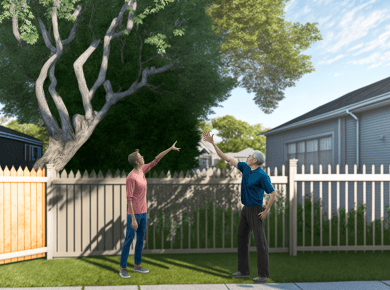
Never remove a boundary tree unilaterally. Talk with your neighbor first; if there is friction, our guide on resolving tree disputes with neighbors can help, and for trees that cross the line see who owns trees on the property line.
Frequently Asked Questions
Is it illegal to cut down a tree in my own backyard?
Usually no for a small, healthy, non-protected tree on private land — but it can be illegal if the tree is a protected species, oversized, in a special zone, or covered by HOA rules.
Can I be fined for cutting my own tree?
Yes, if it was protected or required a permit. Fines range from hundreds to thousands of dollars and may include replacement-planting requirements.
How do I know if my tree is protected?
Check your city or county tree ordinance and confirm with the planning or urban-forestry department; protections often hinge on species and trunk diameter.
This article is general information, not legal advice; tree rules vary by city, county, and state.


 Jack Turner