
In most cases, your electric utility is responsible for trimming trees that grow into its power lines — and it usually does the work for free. Utilities are required to keep vegetation clear of their distribution and transmission lines for safety and reliability, so trees touching those main lines are their job, not yours. The main exception is the smaller service line that runs from the pole to your house, which in many areas is the homeowner’s responsibility.
One rule never changes: never trim trees near power lines yourself. Branches can conduct electricity, and contact can be fatal. This guide explains who handles which lines, who to call, and how to stay safe.
What the utility is responsible for
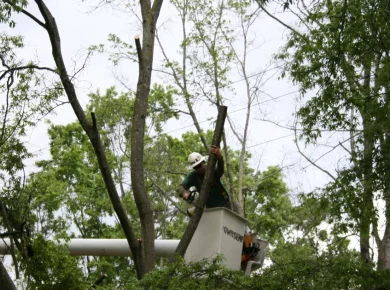
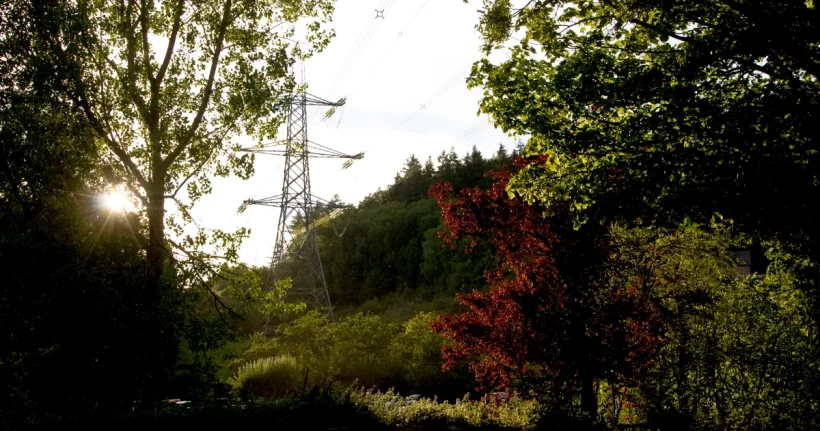
Electric utilities run ongoing “vegetation management” programs to keep trees away from their equipment. They are generally responsible for trimming or removing trees that threaten the primary power lines — the higher lines strung between utility poles and the large transmission lines that carry power across distances. This work is typically done at no charge to you, on a routine cycle or when you report a problem.
Utilities have the legal right to do this through easements and rights-of-way along their lines, which allow crews to trim or remove vegetation that could cause outages or fires. If a tree in your yard is growing into these lines, the utility — not you — normally handles it.
What the homeowner may be responsible for
The line that matters for homeowners is the service drop: the single line that runs from the utility pole to the connection point on your house. In many service areas, the portion of that line closest to your home is the property owner’s responsibility, though policies vary by utility and region — some utilities maintain it too.
Even when the service line is “your” responsibility, you should not cut near it yourself. Instead, call the utility; many will temporarily disconnect the line so a tree service can work safely, or handle the trimming for you.
| Line type | What it is | Usually responsible |
|---|---|---|
| Transmission lines | High-voltage lines between towers | Utility |
| Distribution lines | Main lines along poles on your street | Utility |
| Service drop | Line from the pole to your house | Often the homeowner (varies) |
Who to call and what to say
If you see tree branches touching or growing close to a power line, contact your electric utility’s customer service or vegetation-management line and report the location. They will schedule an inspection and trimming. For a downed or arcing line, treat it as an emergency — stay far away and call 911 and the utility immediately.
What not to do
- Do not climb, prune, or use tools near any power line — even “dead-looking” lines.
- Do not hire a general tree service to work close to energized lines; that work requires specially trained line-clearance crews.
- Keep yourself, ladders, and pole saws at least 10 feet away from lines at all times.
For a tree that needs removal but is well clear of lines, our guides on tree trimming cost and questions to ask before hiring a tree service can help you plan.
Does trimming near power lines cost anything?
Trimming the utility’s own lines is generally free because it protects their system. You may pay only when the work is on your side of the service line and the utility does not cover it, or when you want extra shaping beyond what the utility does for clearance. Utility crews prune for safety and clearance, not aesthetics, so the result can look sparse. If you want a fuller shape afterward, that is on you — see tree removal cost near power lines for pricing when a full removal is needed.
What if it is a neighbor’s tree?
When the tree causing the problem is on a neighbor’s property, you still simply report it to the utility — they deal with the vegetation regardless of who owns the tree, because the hazard is to their lines. You do not need to resolve it neighbor-to-neighbor. If broader tree disagreements come up, see resolving tree disputes with neighbors.
Frequently asked questions
Who trims trees near power lines?
Your electric utility trims trees around its distribution and transmission lines, usually for free. The service line to your house may be the homeowner’s responsibility, but you should still call the utility rather than cut it yourself.
Is trimming trees near power lines free?
Trimming around the utility’s main lines is typically free. You may only pay for work on your service line or for extra shaping beyond safety clearance.
Can I trim a tree near a power line myself?
No. It is extremely dangerous and often illegal. Branches can conduct electricity. Always contact your utility, which uses trained line-clearance crews.
Who do I call about a tree touching a power line?
Call your electric utility to report it. For a downed or sparking line, call 911 and the utility immediately and keep everyone far away.
What about a neighbor’s tree hitting the lines?
Report it to the utility. They handle vegetation near their lines no matter whose property the tree is on.
Disclaimer: This is general safety information, not legal or professional advice, and utility policies vary by provider and location. Never work near power lines yourself — always contact your electric utility.

 Jack Turner